Questions that respond to the case
A conventional form asks for every finding at once. This interview uses the same rule expressions as the classifier to identify which unanswered questions can still change a result or establish a more specific source-defined level.
An answer can make some questions unnecessary while leaving others relevant. Meeting one reaction definition does not automatically remove another. Users can move backward, edit earlier evidence, or open the full question list.
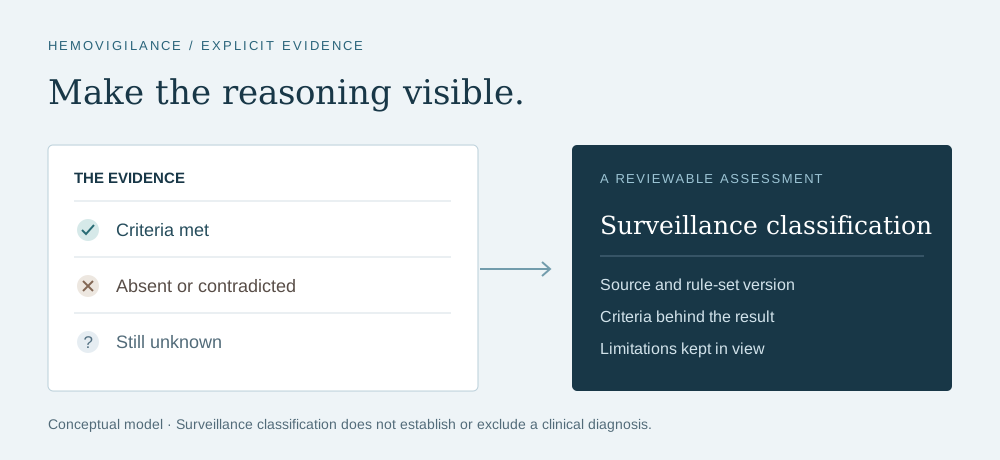
Surveillance classification has a boundary
The current tool evaluates implemented NHSN hemovigilance definitions. Meeting a surveillance definition does not establish a clinical diagnosis; failing to meet one does not exclude a reaction clinically.
That distinction appears on every reaction result. Clinical differential diagnosis, treatment recommendations, severity, and imputability are outside this version’s scope.
Unknown stays unknown
Missing measurements, unanswered findings, and explicit negative findings are different kinds of evidence. The tool preserves those distinctions, including the difference between an omitted value and a measured zero.
Results show criteria met, criteria absent or contradicted, and criteria still unknown. No probability or confidence score is assigned. Where a source includes categories that the current engine has not implemented, the limitation is displayed alongside the result.
Source definitions, visible provenance
The rule set is grounded in the CDC/NHSN Hemovigilance Module Surveillance Protocol, version 3.0, January 2026. Results identify the source section or table and page. Definitions retained in the protocol’s archive are labeled separately from current reporting categories.
Scope and source material
- Current reporting definitions implemented: acute hemolytic transfusion reaction, TACO, TRALI, and transfusion-transmitted infection.
- Previously used classifications retained in the protocol: allergic, delayed hemolytic and delayed serologic reactions, FNHTR, hypotensive reaction, post-transfusion purpura, transfusion-associated dyspnea, and TA-GVHD.
Source version and implemented coverage matter. A result applies only to the rules actually evaluated, and archived classifications do not become current reporting requirements simply because they are available here.
Built for review before validation
The current testing checks specified software behavior using synthetic cases, including overlapping definitions, timing boundaries, missing data, and changes made during an interview. It does not establish diagnostic accuracy or patient benefit.
The next research step is a governed validation pathway with independently reviewed cases. This public prototype accepts no identifiers, requires no account, and has no case-saving workflow.