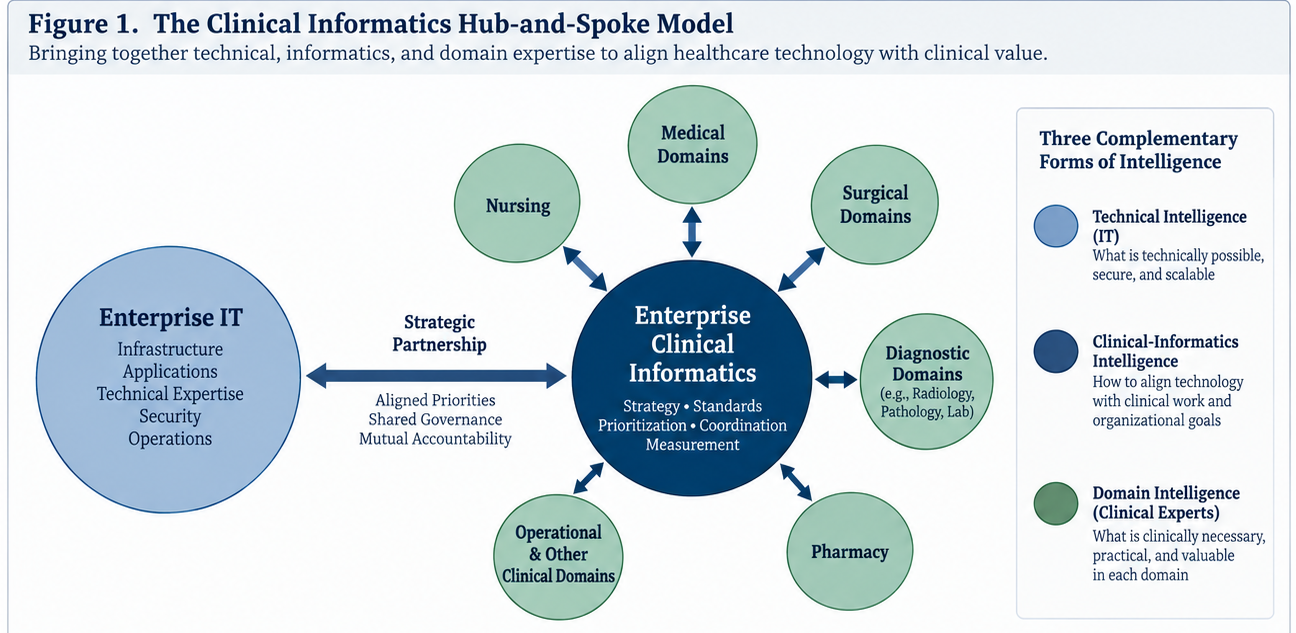
Enterprise IT
Build, integrate, secure, operate, and support the digital environment reliably.
Healthcare technology requires technical intelligence, clinical-informatics intelligence, and deep expertise from the clinical domains. Governance makes their interaction routine rather than accidental.
A Philosophy of Institutional Clinical Informatics · Justin Halls, MD
This is my synthesis of established clinical-informatics, sociotechnical-systems, CDS-governance, and learning-health-system literature. It brings those ideas together into a practical philosophy for how an institution learns, decides, builds, and improves.
Build, integrate, secure, operate, and support the digital environment reliably.
Align information and technology with clinical work, evidence, people, and institutional goals.
Bring the depth of knowledge needed to determine what is clinically appropriate, practical, and valuable in each domain.
These are complementary forms of expertise. None substitutes for the others.
It establishes where needs enter, whose expertise is required, who can decide, how priorities are set, how disagreements are handled, and who remains responsible for results.
Frontline experience must be able to reach the system. Decisions, constraints, and explanations must return to the people who raised the issue.
Expand useful CDS while reducing unnecessary clinician-facing interruption through better targeting, specificity, workflow integration, and lifecycle management.
Create trusted mechanisms to identify friction points, bring the appropriate expertise to them, give them accountable disposition, and explain constraints.
Make it easier for legitimate frontline needs to reach people with the authority and expertise to evaluate and act on them, with a visible path to disposition.
Deployment begins evaluation. Measure adoption, workflow effects, outcomes, unintended consequences, and continuing value. Modify or retire interventions when appropriate.
Tickets, builds, alerts, meetings, and completed projects measure activity. Informatics should increasingly measure patient, clinician, operational, safety, quality, and institutional value.
Clinical decision support makes the model concrete: clinical content, targeting, format, channel, and timing all require the right expertise. A portfolio can keep developing while poor-performing interventions are redesigned or retired.
“The purpose of informatics governance is not to control technology. It is to make institutional intelligence actionable.”