The full philosophy.
The work behind it.
This framework is my synthesis of established literature, informed by clinical practice and the practical questions of institutional decision-making. It is not a claim to have invented these concepts.
A Philosophy of Institutional Clinical Informatics
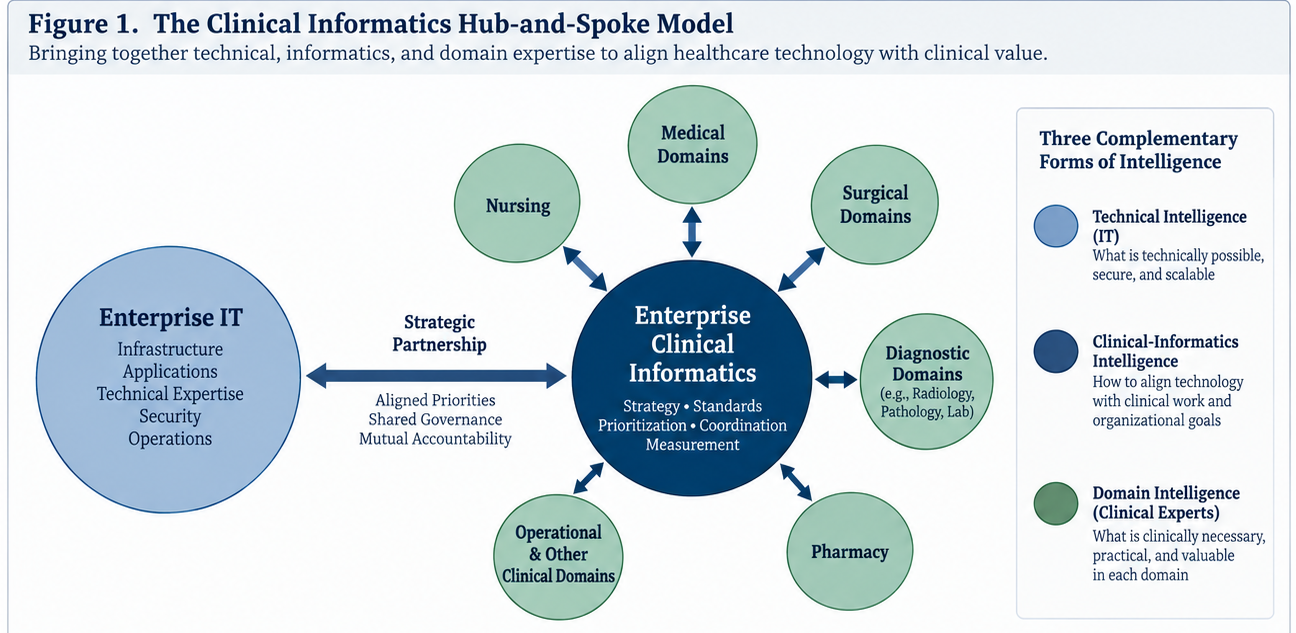
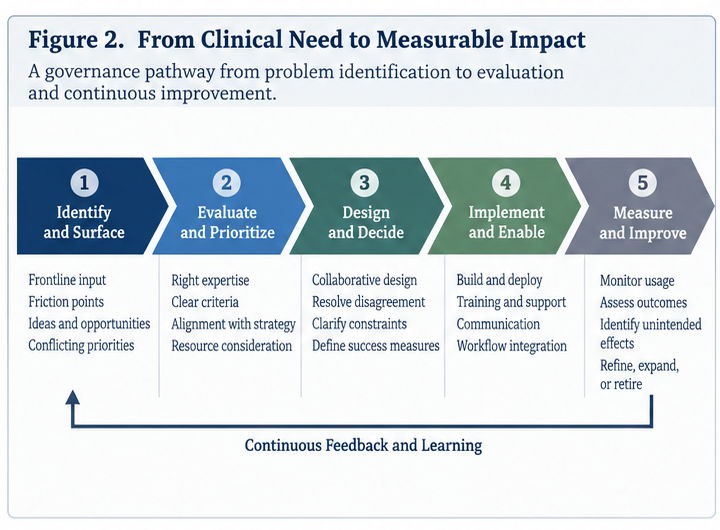
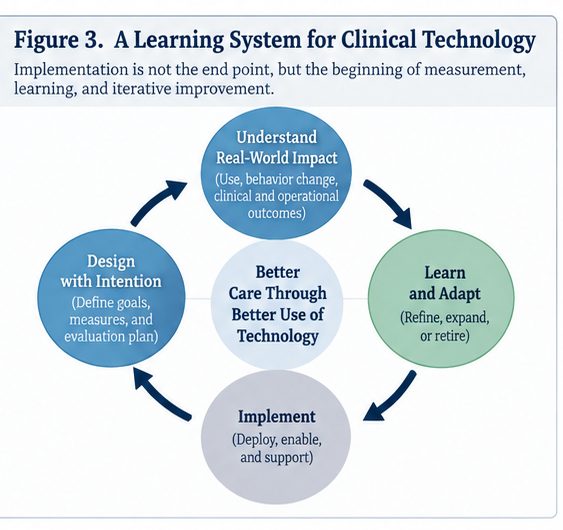
The full paper develops the relationship between technical, clinical-informatics, and domain intelligence; the governance model; friction points; CDS; the five aims; and the learning-health-system endpoint.
The original illustrated edition includes all three conceptual figures. Adding the figures expands this edition to seven rendered pages. The one-page summary provides a compact companion.
Bibliographic corrections to the original drafts
The downloads preserve the original October 2026 documents. Two entries in those drafts require correction: the Utah case study is in AMIA Annual Symposium Proceedings (2018), PMID 30815104, rather than the cited McCoy/JAMIA 2019 attribution. The CCIO task-force report is by Kannry, Sengstack, Thyvalikakath, and colleagues in Applied Clinical Informatics (2016), rather than the listed Kannry/Fridsma JAMIA attribution.
The corrected publication records are linked below. These corrections do not change the philosophy or the reported Utah finding.
Established ideas.
A practical synthesis.
How the literature fits together
Sociotechnical theory explains why IT alone is insufficient. AMIA establishes clinical informatics as a distinct discipline and clinical-informatics leadership as a partner to the CIO. CDS literature explains why domain knowledge and workflow expertise matter; governance experience shows how institutions can organize that expertise and evaluate its effects.
The SAFER Guides connect these responsibilities to safety and accountability. The learning-health-system framework describes the destination: evidence embedded in care, with experience continually generating knowledge that changes the system.
Sittig & Singh
A New Sociotechnical Model for Studying Health Information Technology in Complex Adaptive Healthcare Systems. Quality & Safety in Health Care. 2010;19(Suppl 3):i68–i74.
The sociotechnical foundation: clinical technology is inseparable from people, workflow, clinical content, organizational context, and measurement.
Read the sourceAMIA Clinical Informatics core content
Gardner RM, Overhage JM, Steen EB, et al. Core Content for the Subspecialty of Clinical Informatics. JAMIA. 2009;16(2):153–157.
Defines the discipline underlying clinical workflow, information needs, decision support, systems implementation, and evaluation.
Read the sourceClinical-informatics leadership and the CCIO
Kannry J, Sengstack P, Thyvalikakath TP, et al. The Chief Clinical Informatics Officer (CCIO): AMIA Task Force Report on CCIO Knowledge, Education, and Skillset Requirements. Applied Clinical Informatics. 2016;7(1):143–176.
Establishes clinical-informatics leadership as a capability complementary to the CIO function. It supports a deliberate partnership between technical stewardship and the clinical use of information systems.
Read the sourceThe Five Rights of CDS
Osheroff and colleagues’ CDS Five Rights framework, described in Improving Outcomes with Clinical Decision Support: An Implementer’s Guide, Second Edition, and the federal eCQI Resource Center.
Information, person, format, channel, and point in workflow: an established framework for targeting decision support.
Read the sourceUniversity of Utah CDS governance
A Pragmatic Guide to Establishing Clinical Decision Support Governance and Addressing Decision Support Fatigue: a Case Study. AMIA Annual Symposium Proceedings. 2018;2018:624–633. PMID: 30815104.
The operational example discussed in the philosophy: new CDS continued to be added while reported clinician-facing alert/reminder burden declined by 53.8% over three years.
Read the sourceONC SAFER Guides
Office of the National Coordinator for Health Information Technology. 2025 SAFER Guides.
Safety guidance connecting organizational responsibility, system management, computerized ordering with decision support, communication, and EHR monitoring.
Read the sourceNational Academy of Medicine
Learning Health System framework.
The broader destination: continuous learning and improvement embedded in care delivery.
Read the sourceGrand challenges in clinical decision support
Sittig DF, Wright A, Osheroff JA, et al. Grand Challenges in Clinical Decision Support. Journal of Biomedical Informatics. 2008;41(2):387–392.
Connects interface design, recommendation filtering, knowledge sharing, and prioritization of CDS development. It helps explain why better decision support requires clinical, organizational, and technical work together.
Read the source