Institutional clinical informatics / Governance

A hub for coordination.
Spokes for clinical intelligence.

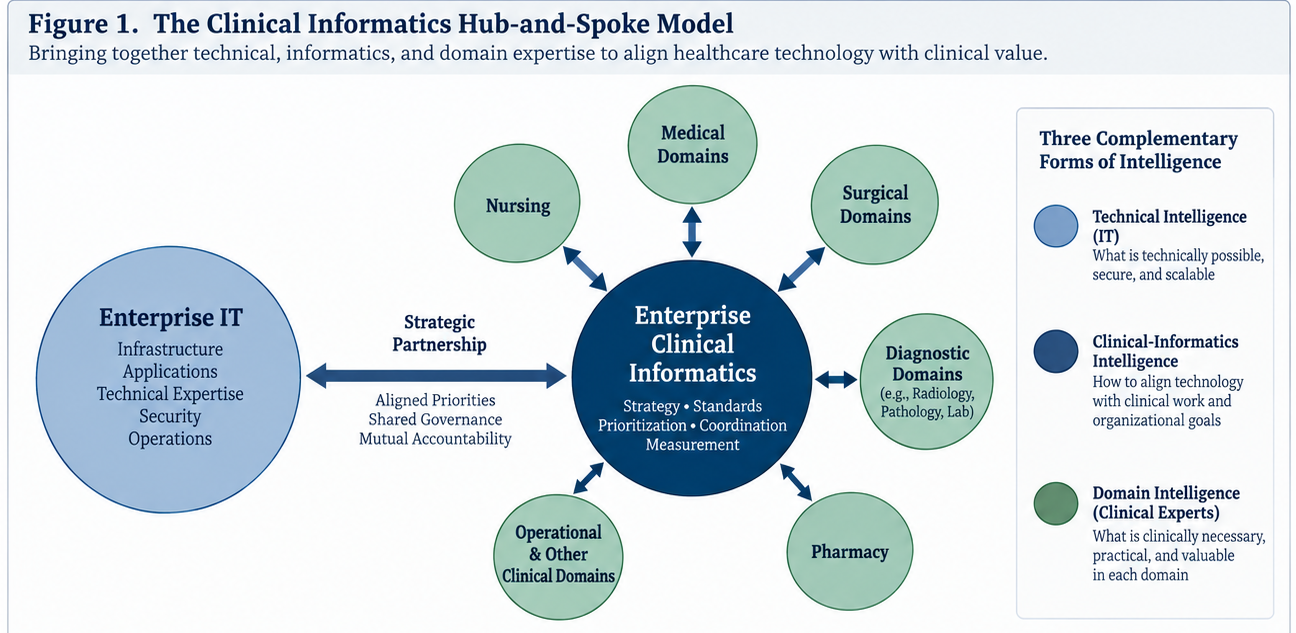
Enterprise Clinical Informatics connects distributed clinical and operational expertise. The hub-and-spoke model brings local knowledge into enterprise decisions and translates shared strategy back into practice.

Hub-and-spoke governance

Distributed clinical intelligence.

Enterprise IT is a distinct strategic partner to the Enterprise Clinical Informatics hub. Bidirectional connections link the hub to distributed clinical and operational domains.
The Clinical Informatics Hub-and-Spoke ModelEnterprise IT is a distinct strategic partner to the Enterprise Clinical Informatics hub. Bidirectional connections link the hub to distributed clinical and operational domains.View full-size figure

The hub connects and stewards.

Enterprise Clinical Informatics holds responsibility for institutional strategy, standards, coordination, prioritization, and stewardship. Centralized expertise should not become an assumption of centralized omniscience.

The spokes translate in both directions.

Domain informatics leaders bring frontline needs, safety concerns, workflow failures, and opportunities into enterprise decisions. They translate enterprise standards, priorities, constraints, and shared solutions back into local practice.

More than representation.

Spokes are mechanisms for distributing clinical intelligence throughout the enterprise. They need people who understand their local work and the principles of informatics, with a clear relationship to the authority needed to act.

Keep a path open from the frontline.

Clinicians need trusted ways to surface needs through or below the spokes. A spoke that becomes a miniature centralized bureaucracy recreates the problem it was meant to solve. Frontline input, visible routing, and feedback to the person raising an issue keep the structure connected to practice.

Decide at the appropriate level.

Local issues can be addressed locally when the necessary expertise, authority, and scope are present. Cross-domain effects, shared resources, enterprise standards, or wider risks require coordination and escalation. This supports local action while preserving enterprise coherence.

From clinical need to institutional action

Make the pathway explicit.

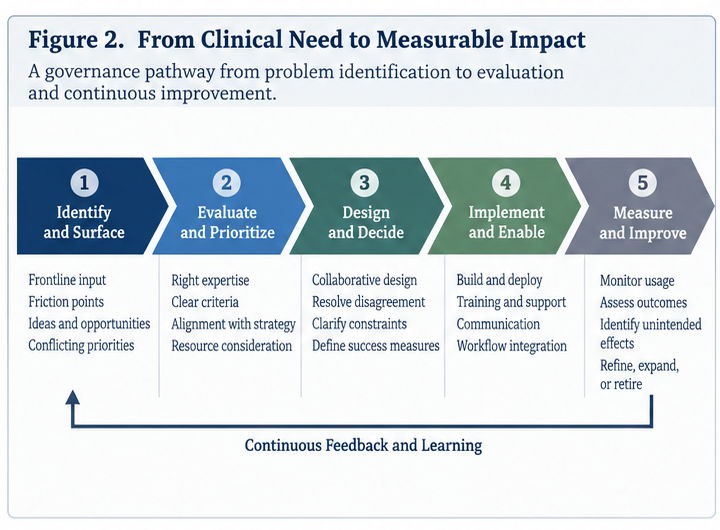
Identify and surface; evaluate and prioritize; design and decide; implement and enable; measure and improve. Continuous feedback and learning connect the pathway back to clinical need.
From Clinical Need to Measurable ImpactIdentify and surface; evaluate and prioritize; design and decide; implement and enable; measure and improve. Continuous feedback and learning connect the pathway back to clinical need.View full-size figure
Where does an idea or problem enter?

Make intake accessible to frontline clinicians. Capture the clinical need and the friction point, not only a requested technical solution.

Who evaluates it, and what expertise is required?

Bring technical, clinical-informatics, and relevant domain expertise together. Each contributes information the others cannot supply.

Is it local or enterprise-wide?

Evaluate who and what the decision affects. Use local authority where sufficient; escalate cross-domain or enterprise implications.

Who has decision rights?

Make authority explicit at the appropriate level, including who resolves competing clinical, technical, local, and enterprise priorities.

How is it prioritized?

Use clear criteria, alignment with institutional strategy, and resource considerations so tradeoffs can be understood.

Who owns implementation?

Name responsibility for design, build, validation, workflow integration, communication, training, support, and continuing stewardship.

How will success be measured?

Define success measures and the evaluation plan before implementation. Measure intended effects, actual use, and unintended consequences.

What happens when stakeholders disagree?

Surface the disagreement, bring in the right expertise and authority, and use an explicit escalation path. Return an accountable disposition and explanation.

A closed ticket is not equivalent to a solved problem.

Surface and navigate friction

Friction points deserve
a credible hearing.

Broken workflows, conflicting priorities, technical constraints, clinician frustrations, and local-enterprise disagreements are information about the system. Healthy governance exposes them rather than hiding them.

Not every friction point can or should be fixed. A legitimate disposition may be to fix it, redesign it, prioritize it later, escalate it, or explain transparently why a constraint cannot currently be changed.

The essential requirement is a credible hearing, an accountable disposition, and a comprehensible explanation. An issue should not disappear into an opaque process.

Steward capabilities
that cross the spokes.

CDS, artificial intelligence, data and analytics, interoperability, patient safety, knowledge management, and digital innovation cross clinical domains. They need enterprise stewardship and common standards while remaining connected to domain expertise.

For AI, model performance, workflow integration, clinical appropriateness, safety, monitoring, and accountability span organizational boundaries. Governance must connect these responsibilities across IT, informatics, and clinical practice.

Healthcare technology
is not IT alone.

Clinical systems sit inside workflows, professional cultures, regulatory constraints, clinical knowledge, and patient-care processes. A technically sound system can still be clinically ineffective or unsafe when it is poorly matched to the work.

The sociotechnical perspective explains why technical performance alone is insufficient. Clinical informatics adds expertise in the clinical use and consequences of information and technology. [1][2]

Technical intelligence

Can this be built, integrated, secured, operated, and supported reliably?

Principally represented by Enterprise IT: infrastructure, applications, architecture, cybersecurity, integration, reliability, technical standards, implementation capacity, vendor relationships, and sustainable operation.

Clinical-informatics intelligence

How should information and technology interact with clinicians, patients, evidence, and workflow to improve care?

Clinical workflow, human-computer interaction, clinical decision support, information needs, usability, implementation, change management, evaluation, and the clinical consequences of digital design.

Domain intelligence

What is clinically necessary, appropriate, practical, and valuable in this field?

Deep expertise distributed across transfusion medicine, oncology, intensive care, pharmacy, nursing, radiology, surgery, and every other clinical domain. No central informatics team can possess all of that depth.
Distinct functions.
Deliberate partners.

Clinical Informatics should not become a shadow IT department or independently determine architecture, security standards, integration patterns, or technical feasibility. Enterprise IT should not independently determine clinical workflow, clinical appropriateness, or clinical decision-support content.

The partnership needs aligned priorities, shared governance, and mutual accountability. Neither function substitutes for the other. Questions at their intersection require both, with clinical domain expertise involved in decisions about care. Governance must define each function’s authority, identify shared decisions, and provide a way to resolve overlapping responsibilities. The purpose is to bring the right expertise together at the right level of decision-making. [3]

Continue exploringThe five aimsDownload the full paper