Adoption and use
Measure whether and how the intervention is used in its intended clinical context.
Clinical experience informs design. Technology is implemented. Real-world effects are measured. The institution learns, systems adapt, and new experience informs the next cycle.
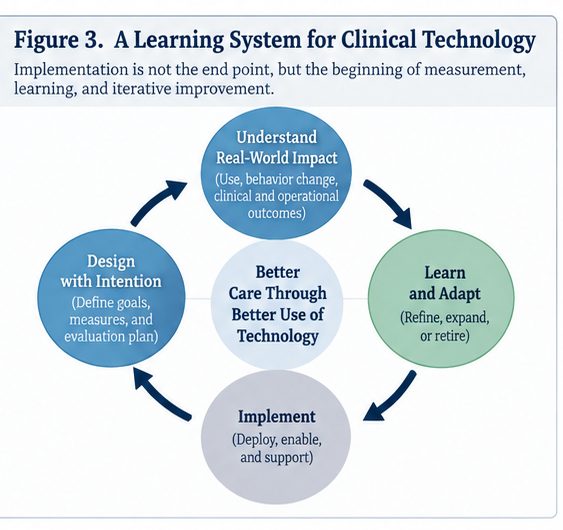
Define goals, measures, and an evaluation plan during design. Implementation includes deployment, enablement, and support. Measurement asks what changed in clinical and operational practice, including effects that were not intended.
The result should feed back into decisions: refine, expand, or retire. Evaluation has little institutional value if the organization cannot act on what it learns.
Measure whether and how the intervention is used in its intended clinical context.
Understand changes in the work itself, including burdens, workarounds, and unintended consequences.
Evaluate the clinical and operational effects the intervention was designed to achieve.
Revisit whether the intervention still serves its purpose and warrants maintenance, modification, expansion, or retirement.
| Activity | Value to examine |
|---|---|
| Tickets, builds, meetings, completed projects | Whether clinical needs received meaningful institutional action |
| Alerts and decision-support interventions created | Useful guidance, appropriate targeting, and effects on clinician work |
| Systems deployed and maintained | Patient, clinician, operational, safety, quality, and institutional value |
Activity remains useful for understanding capacity and workload. It does not by itself establish benefit.
Clinical experience, data, evidence, technology, and governance form a continuous improvement loop. The National Academy of Medicine’s framework provides the broader foundation for aligning learning with everyday care. [7]
“The purpose of informatics governance is not to control technology. It is to make institutional intelligence actionable.”