Developing a deterministic approach to calculations, pattern classification, and concise reporting for coagulation mixing studies.
Development / October 2026
Where the project stands
A public development tool now supports keyboard-first manual entry, local screenshot extraction, and provisional interpretation using explicit, versioned calculations.
The primary output follows web-chang-v0.1, the local Chang-based method with corrected matched-time arithmetic. A separately labeled ICSH 2024 candidate comparator makes method disagreement visible. Clinical validation remains pending.
Three fully synthetic patients let visitors try the workflow. Demo observations are excluded from the case corpus and clinical validation.
Public development demo: manual entry, screenshot extraction, and provisional calculations; clinical validation pending.
My role
Clinical scope, interpretive logic, reporting design, and validation planning
A deliberately narrow clinical role
I am developing this project around a limited question: can explicit, reproducible interpretation help a mixing study function as a screen that directs further diagnostic workup?
The assay has limitations, and delayed interpretation can reduce its practical value. Automation should make the result easier to review and use while preserving those limits. A pattern classification should not be presented as a definitive diagnosis.
The intended workflow
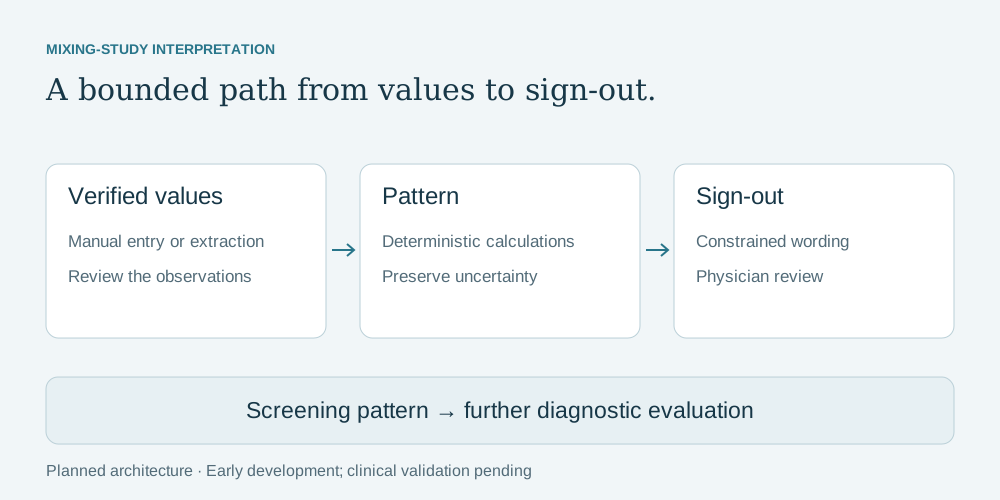
A screening pattern, with its limits intact. Planned workflow illustration for a project in early development.
The planned pipeline starts with raw observations, applies deterministic calculations, classifies the supported pattern, and produces a concise sign-out for physician review. Calculation logic and report language are separate, so that both can be checked independently.
The initial input scope is manual entry or screenshot-derived measurements. Extracted measurements would be displayed for verification before interpretation. Ancillary test results are outside the initial input scope.
Bounded interpretation
The developing specification considers correction patterns, persistence of abnormality, and changes with incubation. Candidate reporting categories include patterns consistent with factor deficiency, inhibition, time-dependent inhibition, and equivocal or indeterminate findings.
Those categories describe what the mixing-study observations support. They should preserve uncertainty and point toward further evaluation without inferring a specific disease or mechanism beyond the evidence.
Reproducible and reviewable
Calculation definitions, thresholds, and reporting rules need explicit versions. Each output should retain the input observations, calculations performed, rules applied, and the wording generated, with reviewer decisions recorded separately.
Case accumulation and provenance are part of the development process. The aim is to build infrastructure that can be evaluated against reviewed cases rather than rely on free-form interpretation.
The underlying philosophy
From clinical need to institutional action.
These projects connect clinical expertise, usable systems, and accountable decisions—the same concerns that shape my approach to clinical informatics.