
From observations
to reviewable reasoning.
Serologic asks whether expert serologic reasoning can be represented as explicit, source-grounded, testable computational rules. Its intended architecture keeps three things distinct: what was observed, what the engine infers, and what a reviewer concludes.
Research and educational prototype. Not validated for clinical use.

What an antibody
panel contains.
Rows of reagent red cells, columns of antigen profiles, and the observed reactions at different testing phases: the information that structured interpretation begins with.
This educational illustration shows the panel format with interpretation annotations. It is not a real case submitted to Serologic, a software screenshot, or an engine-generated result. The colored markings belong to the original illustration.
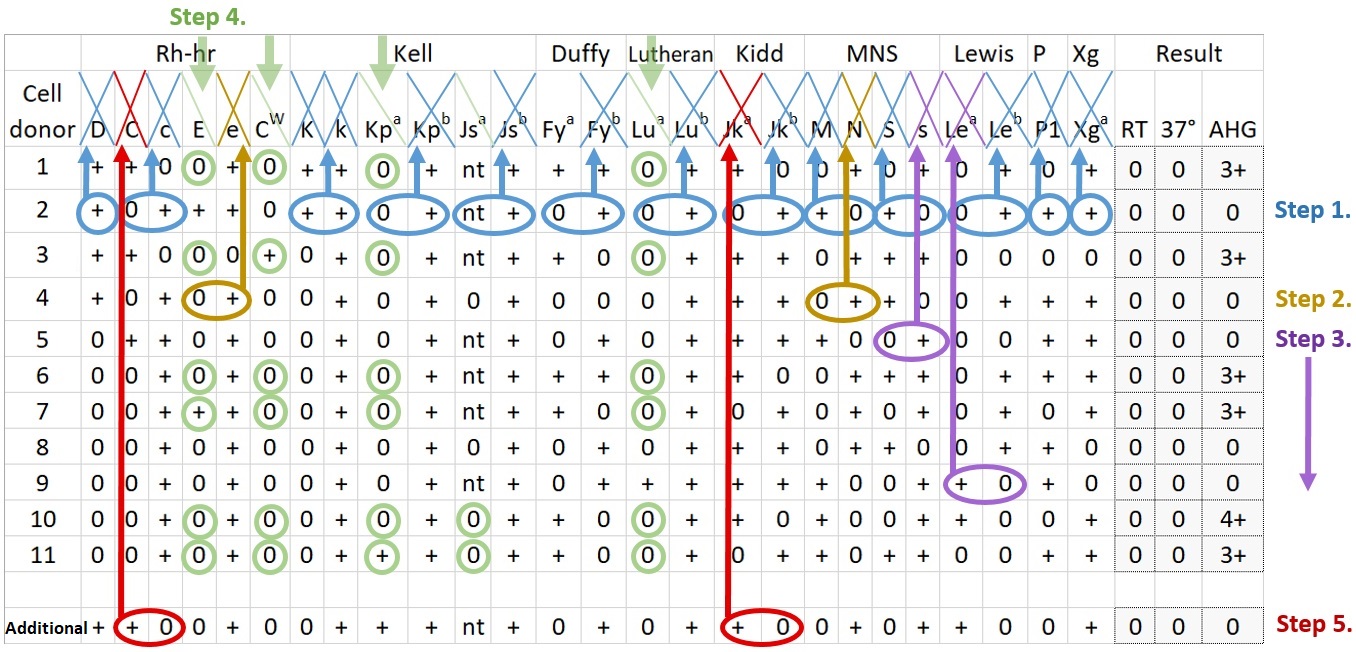
Serologic’s intended workflow separates these laboratory observations from computed inference and the reviewer’s interpretation. A future image-input workflow would require review of the extracted table before inference.
Three distinct responsibilities.
- 01 / OBSERVATIONS
Establish the input.
Organize laboratory observations, antigen profiles, reactions, testing method and phase, and available relevant context. Preserve unknown and not-tested values.
If AI extracts observations, a person verifies them before inference.
- 02 / COMPUTED INFERENCE
Apply explicit rules.
The deterministic engine evaluates structured observations against versioned rules. The goal is to connect each conclusion to the evidence and reasoning behind it.
The rule engine carries the serologic inference.
- 03 / HUMAN INTERPRETATION
Review the conclusion.
A reviewer evaluates the computed result alongside the investigation. Acceptance or a reasoned override remains distinct from the engine’s inference.
Human interpretation is a separate, accountable step.
Keep the path
to the conclusion.
The intended output makes supporting observations, contradictory findings, unresolved alternatives, and the rationale for suggested next steps available for inspection.
A concise interpretation should come first. The evidence should be close enough to examine without turning every result into a long narrative.
This describes the intended output design. Public demonstrations will identify what their specific engine version actually returns.
Explicit rules and reproducibility
Deterministic reasoning makes the rule application inspectable and testable. Reproducing a result requires retaining the structured input and the engine, knowledge-base, and policy versions used for the run. A language-model explanation should not be confused with the computation itself.
Sources and interpretation policy
Source provenance connects rules to the material that supports them. Policy configuration makes interpretation choices explicit. A versioned account of the rules and policies helps distinguish a software change from a change in the interpretation approach.
Uncertainty and completeness
A pattern that fits does not, by itself, settle every alternative or explain every finding. The design separates support for a proposed interpretation from the completeness of the investigation. Missing or insufficient evidence should remain visible.
Additional testing and escalation
Serologic’s initial focus is routine red-cell alloantibody interpretation, not every reference-laboratory problem. The intended behavior includes recognizing when the evidence is insufficient or expert review is needed. A demonstration should show only next-step suggestions actually returned by its identified engine version.
From a worksheet image
to verified observations.
A future photo workflow would place the source image beside an editable table, flag ambiguous entries, and require review before running the engine. Multiple images may be needed to capture both the antigen matrix and reactions.
Missing information must stay missing: a blank is not automatically negative, an absent antigen matrix cannot be inferred from reactions, and extraction confidence is not serologic confidence.
Photo input is not available on this site. Processing, retention, and permission requirements need to be established before an upload workflow is enabled.
Illustration credits
Red-cell illustrations by Sarbasst Braian, via Wikimedia Commons: BloodCellState 001 and BloodCellState 159. Released under CC0 1.0. Illustrations, not microscopy or case evidence.

